Will they fit? A free wheel and tyre calculator
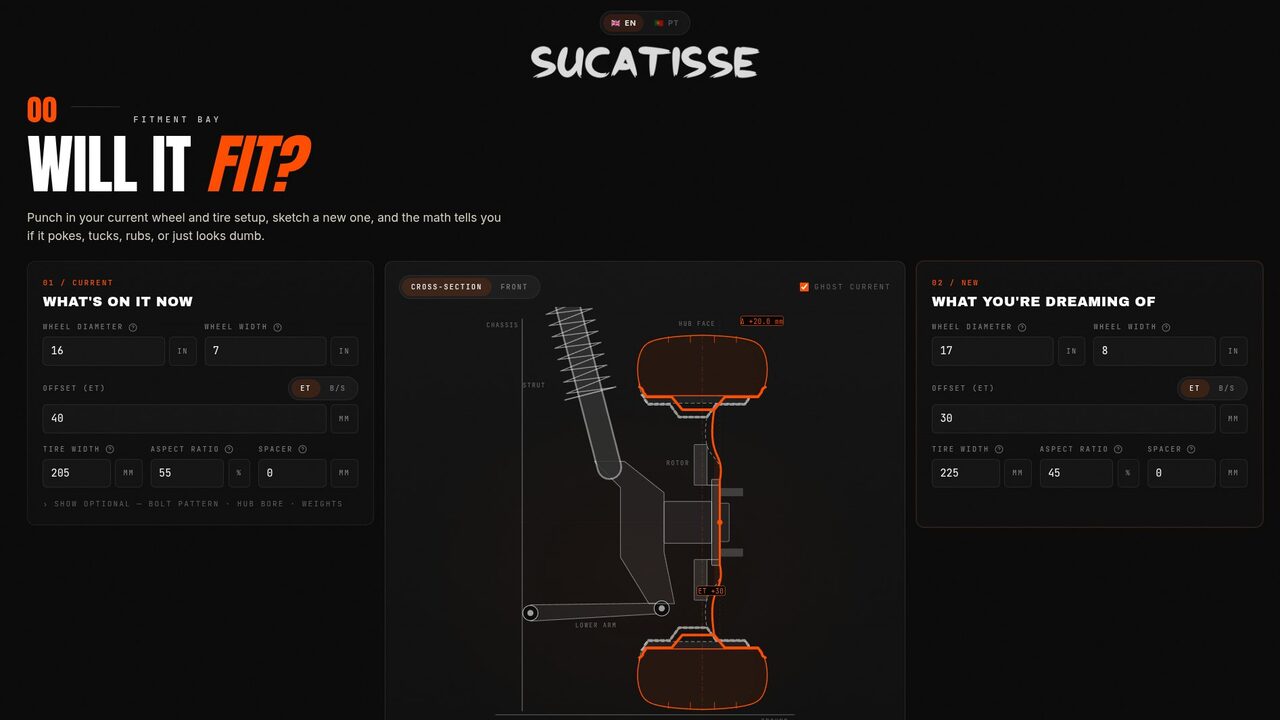
Buying wheels blind is how you end up with a boot full of expensive paperweights. This tool answers the one question every wheel purchase starts with: will they fit, and what changes if they do? You describe what is on the car now, describe what you are shopping for, and it draws both and does the maths. It runs entirely in the browser, works in English and Portuguese, and the whole setup lives in the URL so you can send it to a mate for a second opinion. No 3D, no login, no account.
Describe both setups
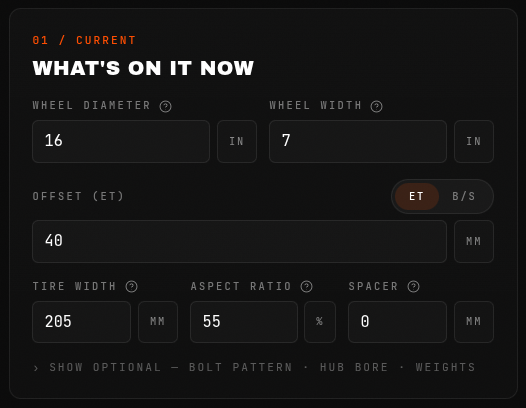
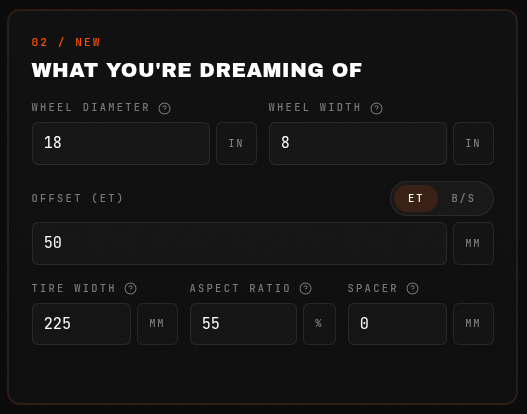
Left is what is on it now, right is what you are dreaming of.
Fill in what is on the car today from the door-jamb sticker as current, and the wheels you are eyeing as new. For each side you enter wheel diameter and width, offset, tyre width and aspect ratio, and any spacer.
A couple of fields are worth knowing. Offset has an ET / backspacing toggle, so you can type whichever number the seller gives you and it converts the other for free. A spacer pushes the wheel outward, which is the same as reducing offset. Behind the “show optional” link you can add bolt pattern, hub bore and wheel or tyre weights, and there is an overall-diameter override for oddball flotation sizes that do not follow the usual width and aspect maths.
Look at the picture
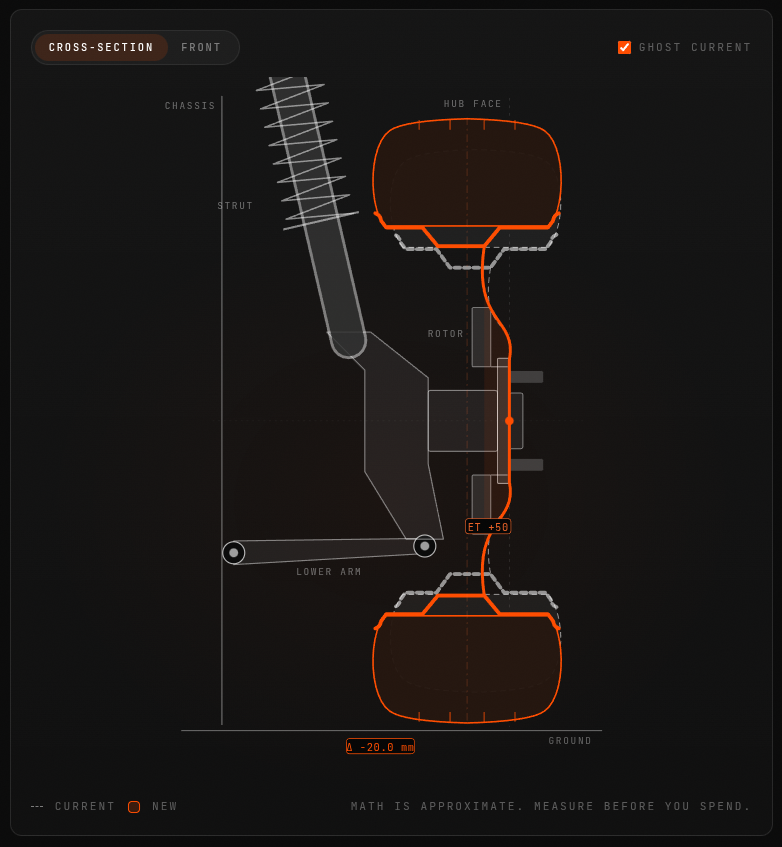
A true-scale slice through the wheel. Dashed is current, orange is new.
The cross-section is drawn to real proportions, no exaggeration, so what you see is what you get. It puts your wheel next to the strut, lower arm, rotor and hub, and overlays the current setup as a dashed ghost. The orange callouts are the ones to read: the ET marker at the mounting face, the poke across the outer edge, and the gap at the inner edge. If the inner edge marches toward that strut, you have a rub coming.
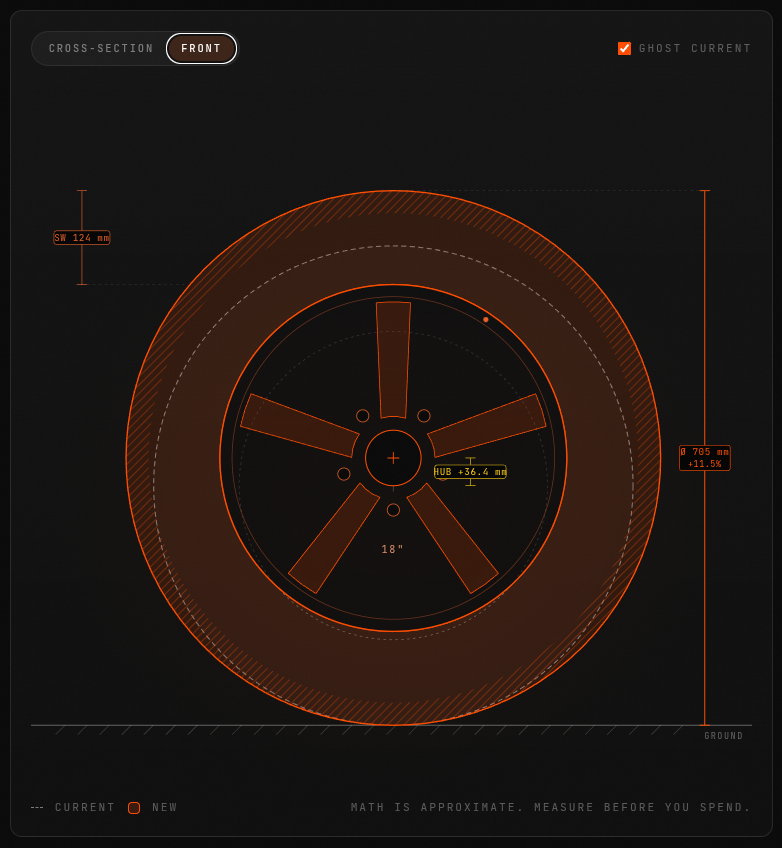
Because both wheels sit on the same ground line, a diameter change shows up as the hub moving, which is your real ride-height change.
The front view does one thing that is easy to miss. Both the old and new setups stand on the same ground contact point, so a bigger tyre does not draw as two neat circles, it lifts the hub. That vertical shift is the ride-height change you will actually feel. The Ø callout gives the new overall diameter and how far off the old one it is, and SW is the tyre section width.
Read the math
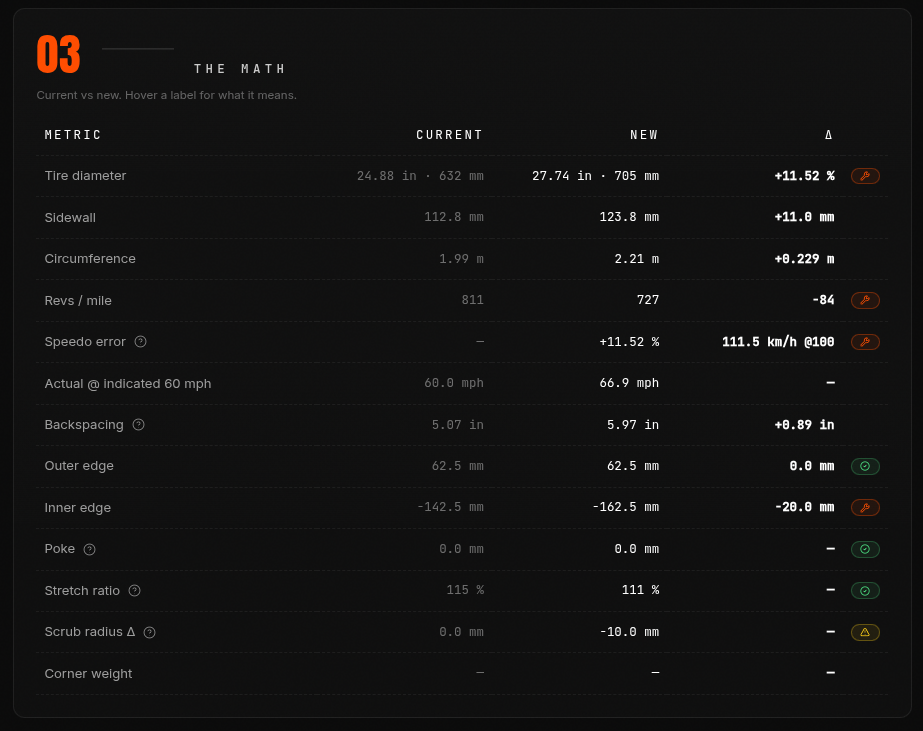
Every number, current versus new, with a plain traffic-light on the right.
This is where it earns its keep. Take the worked example: going from 16x7 with 205/55 to 18x8 with 225/55 on more offset. The tyre grows about 11.5%, so the speedo reads 11.5% slow, an indicated 100 is really about 112, and revs per mile drop. Poke here is basically zero, the face stays put, but the inner edge moves 20 mm inboard, which is the amber-to-red kind of number that rubs. Stretch ratio tells you how the tyre sits on the rim, around 100 to 130% is normal, below that is stretched. Scrub radius shifts about 10 mm, a heads-up for steering feel. Each row carries a chip:
| Chip | What it means |
|---|---|
| Green | Fine, order it |
| Amber | Measure before you order |
| Orange | Probably will not fit as is |
Then read the warnings
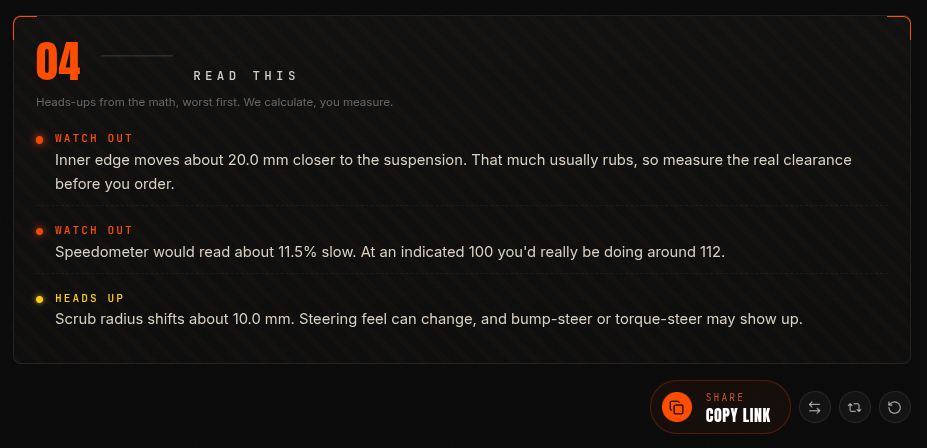
It calculates, you measure. That line is on the tool for a reason.
The last panel says the same thing in words, worst first, so you do not have to interpret the table. Inner edge moving 20 mm closer to the suspension, so measure the real clearance. Speedo reading 11.5% slow. Scrub radius shifting, so expect a change in steering feel and maybe some bump or torque steer. It is a briefing, not a verdict.
What to trust, and what to measure yourself
Use it before you buy, and to sanity-check an offset or spacer change. Lean on the poke and inner-edge numbers for fender and rub risk, and the diameter and speedo numbers for gearing and keeping the clock honest. Treat scrub radius as a coarse hint, since it does not know your kingpin geometry. And know what it cannot see: the exact shape of your arch, your camber, real suspension travel at full lock, and the fact that a 225 from one brand measures wider than another. That is why every screen ends with the same line. The tool does the arithmetic; you still get under the car with a tape measure before you spend.
Try it at fit.sucatisse.com.