Spring Bay: work out your spring rates
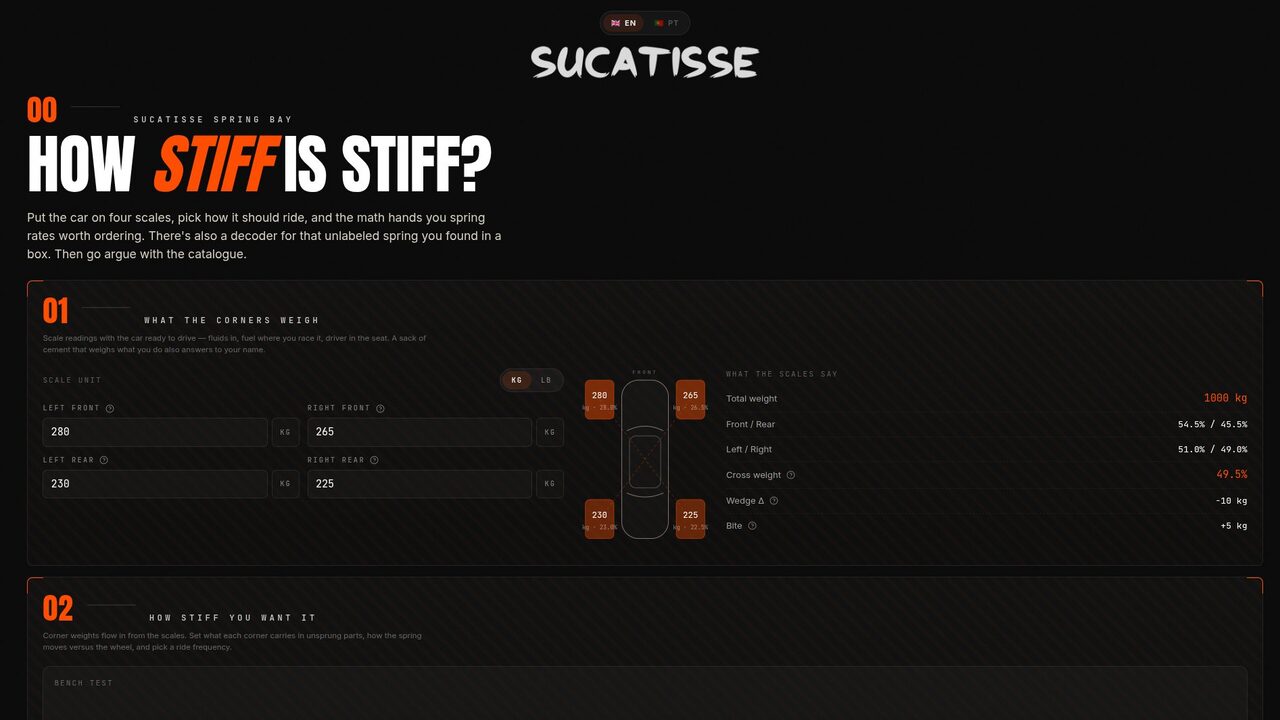
Spring rates are where a lot of budget builds fall apart. Someone copies a number off a forum, buys the springs, and then wonders why the car pogos down the road or scrapes over every speed bump. Spring Bay is our attempt to make that decision boring and correct. It does three jobs: balance the car on scales, turn a target ride frequency into an actual spring rate, and decode a spring that has lost its label. It runs in the browser, works in English and Portuguese, and every setup lives in the URL so you can send it to whoever is holding the wallet.
Weigh the corners
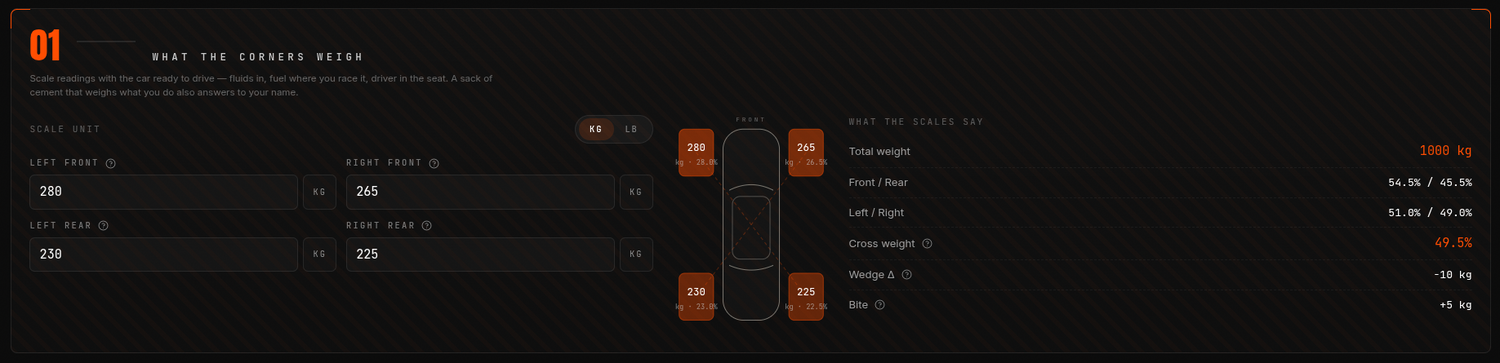
Four scale readings in, balance out.
Put the car on four scales the way you actually drive it: fluids in, fuel at the level you run, and you in the seat. A sack of cement that weighs what you do works if you are short a driver. Type the four numbers in, flip between kg and lb if you need to, and the right-hand panel does the sums.
The one to watch is cross weight. It is the diagonal, the right front plus the left rear, as a share of the total. At 50% the car turns as well one way as the other. Ours reads 49.5%, close enough that it has no favourite direction. Wedge is the same idea in kilograms, so zero wedge and 50% cross are the same target. Bite is an oval-track number. On a road or circuit car you can ignore it.
Pick your stiffness
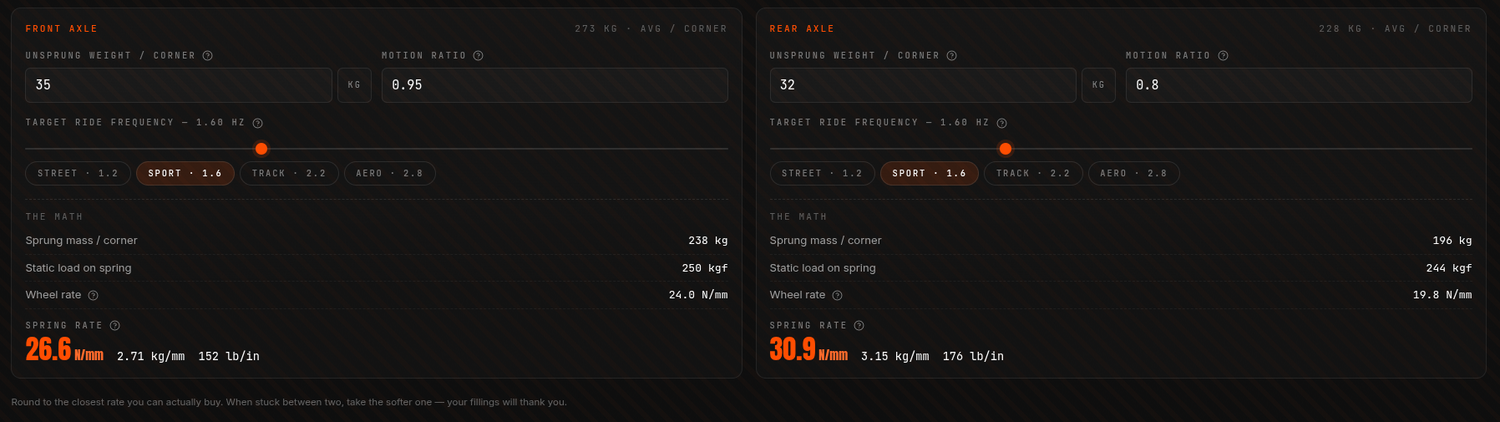
Front and rear are worked out separately.
This is the part most calculators skip. You do not pick a spring rate directly, you pick a ride frequency and let the maths hand you the rate. Ride frequency is how many times a second the car bobs on its springs with the dampers taken out of the picture. Low is soft, high is stiff. The presets are your map:
| Preset | Hz | Feel |
|---|---|---|
| Street | 1.2 | Soft, daily driver |
| Sport | 1.6 | Firm road and track |
| Track | 2.2 | Circuit stiff |
| Aero | 2.8 | Basically glued down |
Two inputs per axle matter. Unsprung weight per corner is everything the spring does not hold up: wheel, tyre, brake, hub, roughly half the arms. Motion ratio is how far the spring moves for each millimetre the wheel moves, and it bites hard because the spring rate scales with its square. A coilover mounted near the wheel sits close to 1, an old damper tucked inboard can be 0.7 or less.
Give it the corner weights, unsprung mass, motion ratio and a frequency, and it returns the spring rate in N/mm, kg/mm and lb/in all at once. Round to a rate you can actually buy. Stuck between two, take the softer one. A trick worth using: make the rear a touch stiffer than the front, somewhere from 5 to 25 percent, and the car settles after a bump instead of bouncing twice.
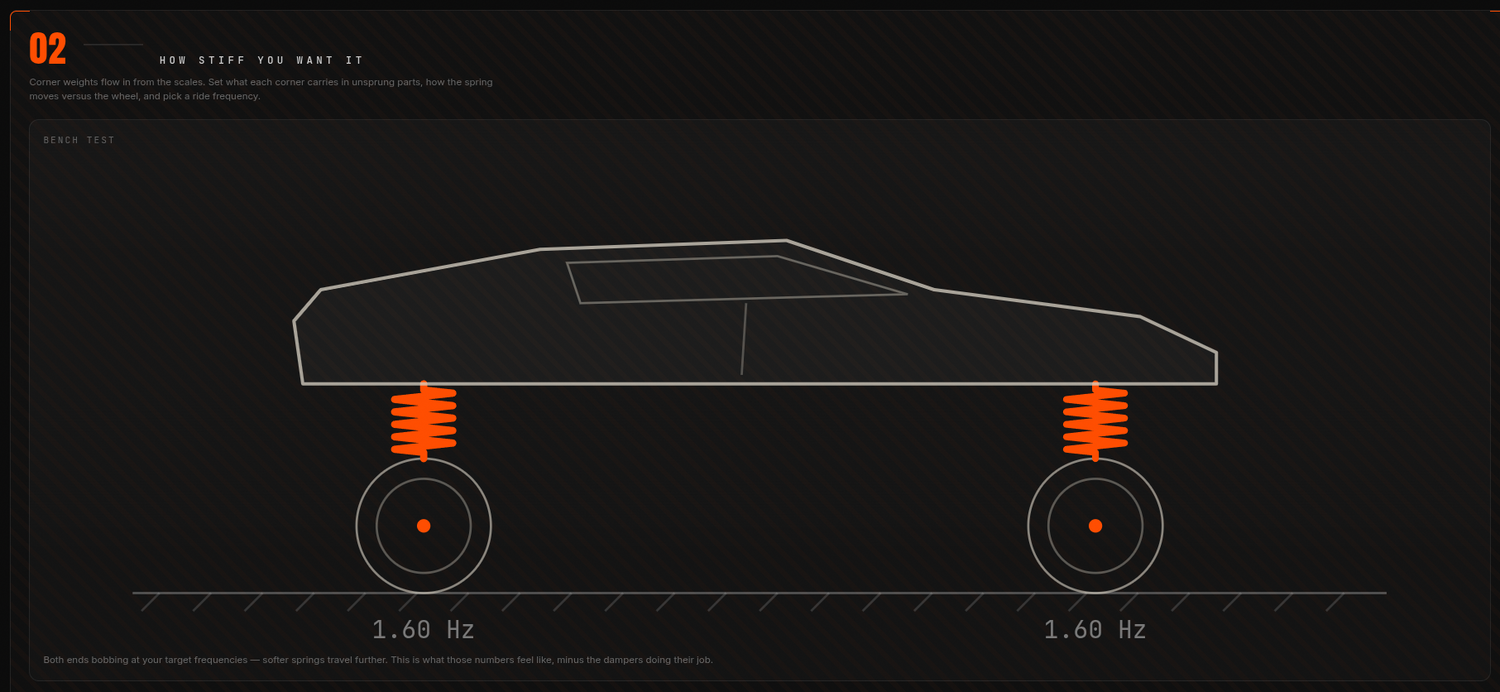
Softer springs travel further. This is what the numbers feel like, before the dampers do their job.
Decode a mystery spring
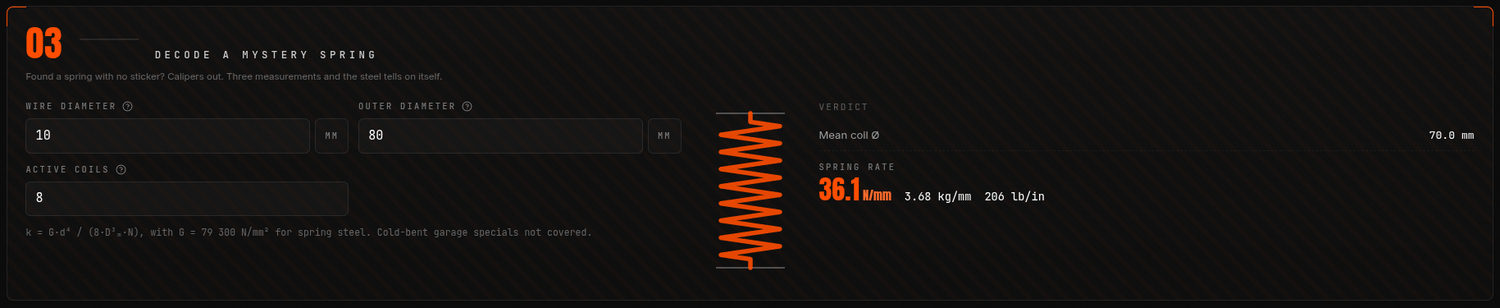
Wire diameter, outer diameter, active coils.
Every garage has a shelf of springs with no labels. Three measurements sort them out. Measure the wire diameter, the outer diameter, and count the active coils, the ones that actually flex, not the flat dead coil at each end. The tool subtracts one wire thickness to get the mean coil diameter and runs the standard formula, k = G·d⁴ / (8·D³·N), with G set for spring steel.
Measure the wire carefully. Rate climbs with the fourth power of the wire diameter, so being half a millimetre out on a 10 mm wire throws the answer off by about a fifth. Our mystery spring lands at 36.1 N/mm.
What the advisor flags

It calculates, you measure.
The last panel reads the numbers back worst-first, in plain language. Cross weight more than a couple of points off 50 gets a warning to check the scales are sitting level. A rear softer than the front gets a note. And the decoded spring is matched against your front and rear targets, so it can tell you a spring is 17% off the rear and better used as a paperweight.
When to reach for it
Three moments: you are on the scales chasing balance, you are choosing springs for a target feel, or you are trying to identify something off the shelf. Spend your attention on wire diameter and motion ratio, because those two move the answer the most. Ignore bite unless you race ovals. And treat every number as a starting point you confirm with a tape measure and a test drive, not gospel.
Have a go at springs.sucatisse.com. It is the same tool we lean on for the club Micra.